
You Can’t Buy Innovation
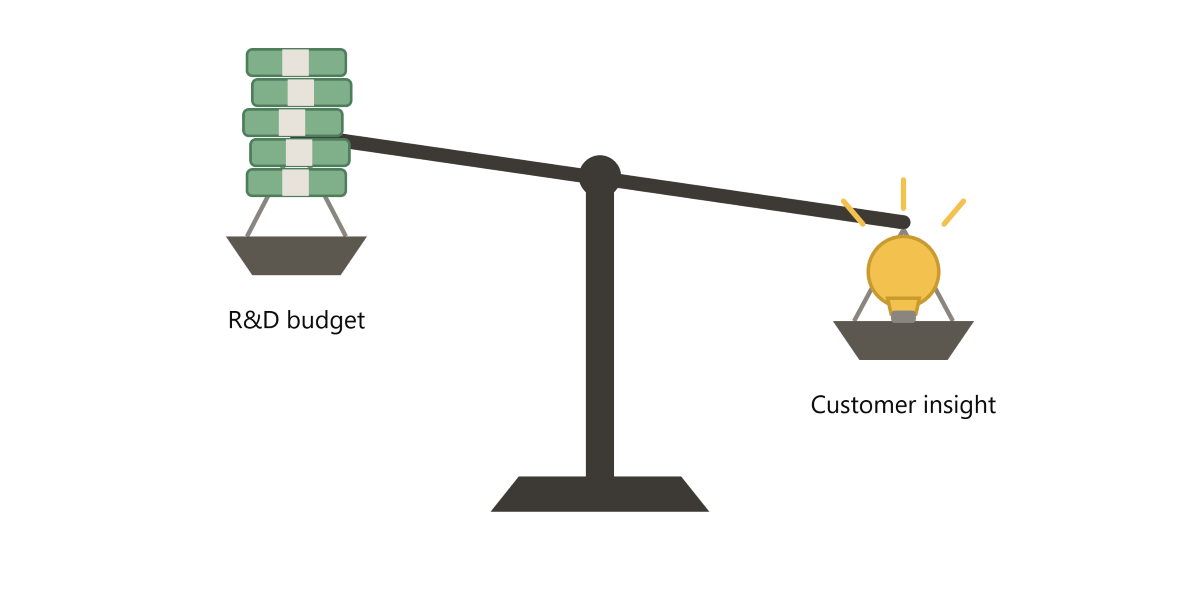
The most consistent finding across the fourteen annual Global Innovation 1000 studies of the world’s thousand biggest R&D spenders is one most executives still find hard to believe: there is no long-term correlation between what a company spends on innovation and its overall financial performance. In the study’s final year, 2018, the thousand companies invested a record $782 billion in R&D. The verdict did not budge. Ouch.
I revisited these studies while doing some research for the certification course on Lean JTBD OS® that I’m developing, and I was impressed with how clear and important some of the findings are, even in the AI era. If anything, their central finding matters more now, for reasons I’ll come back to at the end.
The study’s first edition in 2005 was titled “Money Isn’t Everything,” and fourteen years of data never upended that finding. The findings were consistent: companies that outspend their rivals rarely out-innovate them, and the companies that out-innovate their rivals are rarely the biggest spenders. What separates the winners is not how much they spend but which innovation strategy they choose.
One of Three Strategies Wins
The study’s authors, first at Booz Allen Hamilton and later at Strategy&, part of PwC, classified companies into three innovation strategies. Technology Drivers lead with technical capability and let R&D point the way to breakthroughs. Market Readers watch their markets closely and move fast to improve on what others have proven. Need Seekers engage current and potential customers directly to uncover unarticulated needs, then work to be first to market with solutions that address them.
The study found Need Seekers more likely to outperform their rivals financially than companies following either of the other two strategies. In its final survey, Need Seekers were the strategy most common among companies reporting higher revenue growth and profitability than their industry peers. Six of the ten companies executives named most innovative were Need Seekers, while only two of the ten biggest R&D spenders were. The pattern held through the study’s final edition in 2018, where the ten companies named most innovative again outperformed the ten biggest R&D spenders on revenue growth, margins, and market capitalization growth. R&D pays off when customer insight directs it. Spending alone never did.
Customer Focus Is Not Need Seeking
Many companies are genuinely customer-focused, striving to understand their customers through sales conversations, support tickets, satisfaction surveys, and user feedback. But customer focus does not make a company a Need Seeker, because what customers volunteer through these channels naturally arrives as solution requests, feature ideas, and complaints about today’s products.
The problem is not the effort. It is what information the effort collects. Henry Ford and Steve Jobs were only half right when they warned that customers can’t tell you what they want. Customers genuinely cannot tell you what to build, but they can absolutely tell you what they are trying to get done and where today’s solutions fall short. The catch is that you must know what type of customer inputs to obtain and how to get them. Competitive advantage from customer insights is not created through regular interaction with customers. It is created by obtaining the specific information you need to create unique value in the market.
The Study Names the Capability. It Does Not Supply the Method.
The study names exactly what that specific information is. Strategy&’s profile of the Need Seeker puts one capability at the top of the list: directly generated deep customer insights that identify latent and unexpressed needs and translate them into new products and services.
By 2018, companies at every level of performance, faster-growing and slower-growing alike, ranked the ability to obtain deep customer insights as the most important ideation capability. And the capability framework leaves the other two strategies no exemption: regardless of their strategy, all successful innovators must be able to translate customer needs into new products and services. Companies know the capability matters. What most lack is a disciplined method for building it.
Jobs-to-be-Done is the discipline that closes that gap. Instead of studying customer attributes, preferences, and feature requests, or a hodge-podge of different kinds of “needs,” discovery is anchored on the customer’s job, what they are trying to get done, and the desired outcomes they use to judge success at each step along the way. Jobs and desired outcomes are decoupled from products and services so they are stable over time while solutions continually evolve. This makes them a viable foundation on which to build your strategy.
This is the discipline I built Lean JTBD OS around: a system that reveals what customers are trying to accomplish and where they struggle, before ideas are generated and tested, so teams know where to focus and what to do to create new value.
The Capability, Not the Checkbook
The bottom line: innovation leadership cannot be obtained through R&D spending. It is earned by developing the capability to turn customer needs into new products and services. The Need Seekers prove that capability pays, because their strategy is built entirely on it. But naming the capability is only the start. The study’s first edition concluded in 2005 that superior results come from the quality of the innovation process, not the size of the budget, and that innovation may be the least consistently managed of all core business functions. Building the capability requires a repeatable process for uncovering customers’ latent and unexpressed needs and transforming them into new products and services. That process is a discipline any team can learn.
If anything, the stakes have grown since the study ended. The European Commission’s scoreboard of the world’s 2,000 largest corporate R&D investors put their 2024 spending at 1.45 trillion euros (about $1.56 trillion), over 90 percent of all business-funded R&D worldwide, and the biggest AI builders drove the fastest growth.
AI has made everything downstream of customer insight faster and cheaper: generating ideas, drafting concepts, building prototypes. What it cannot do is replace customers as the source of needs they have never expressed. Those needs don’t appear in any data an AI can mine; they surface only when the right inputs are obtained directly from customers. When hundreds of ideas can be generated in a moment, the advantage moves entirely to knowing which needs are worth pursuing.
For those who want to put this into action, we’re doing the final design of the Customer Needs Discovery Guide, a step-by-step guide to uncovering unmet customer needs that can be transformed into new products and service. Get priority access by signing up here: Customer Needs Discovery Guide.
Sources: Jaruzelski, B., Dehoff, K., & Bordia, R. (2005). Money Isn’t Everything. strategy+business, 41 (Winter). Booz Allen Hamilton. | Jaruzelski, B., Loehr, J., & Holman, R. (2011). The Global Innovation 1000: Why Culture Is Key. strategy+business, 65 (Winter). Booz & Company. | Strategy&. (2015). The “Need Seeker”: Innovation Strategy Profile and Capability Requirements. PwC. | Jaruzelski, B., Chwalik, R., & Goehle, B. (2018). What the Top Innovators Get Right. strategy+business, 93 (Winter). Strategy&, PwC. | European Commission, Joint Research Centre. (2025). The 2025 EU Industrial R&D Investment Scoreboard.