
Why Successful Companies Make Bad Innovation Bets
Here’s something I see repeatedly: companies that excel at operations still make poor innovation bets. It’s not a competence problem. It’s a data problem. They have delivery knowledge in abundance. What they lack is jobs-and-outcomes knowledge. And that gap is where market risk lives.
The Blind Spot in Plain Sight
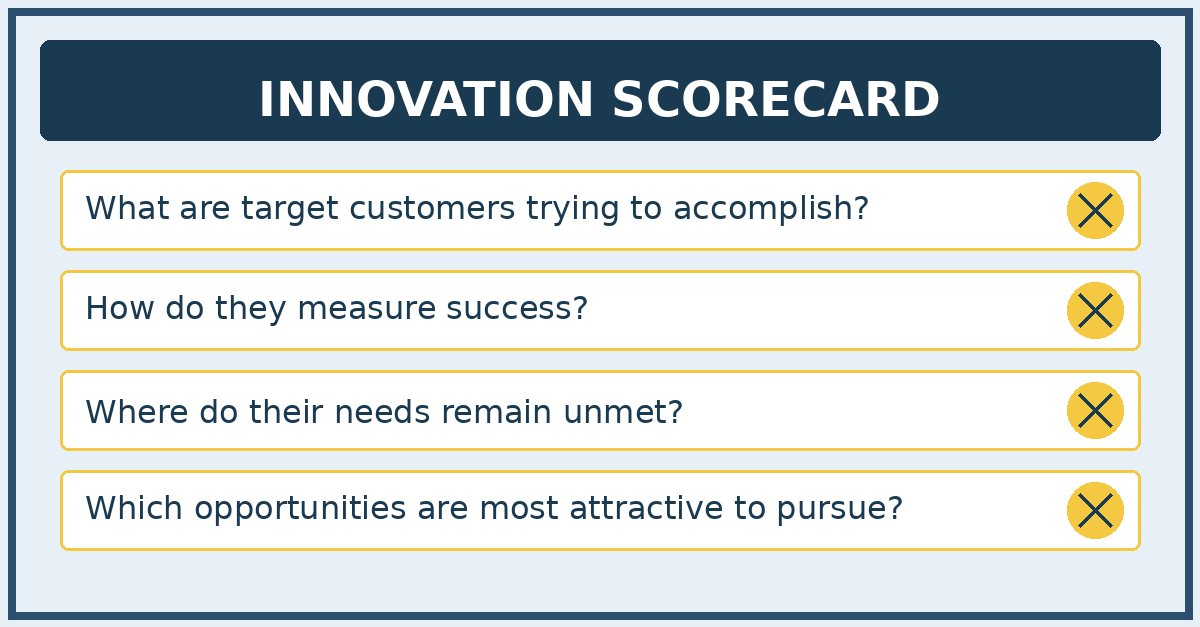
Your delivery dashboards look complete. They tell you how you’re doing today. Your pipeline reviews feel disciplined. They show what shipped and how it performed. But neither answers the questions that matter for innovation: What are our target customers trying to accomplish, how do they measure success, and where do they still struggle?
Until leaders and product teams understand these are two different data sets, operational excellence will mislead them, make them overconfident, and ensure high failure rates.
Two Different Questions, Two Different Data Sets
Delivery knowledge answers: “How well are we running current operations?” It tracks what customers do: conversion rates, engagement, churn, feature adoption. This knowledge runs today’s business but reveals very little about tomorrow’s opportunities.
Jobs-and-outcomes knowledge answers: “What are customers trying to accomplish, and how do they measure success?” It reveals the job customers want done, the outcomes they use to measure success, which needs remain unmet, and which are most attractive to pursue for new value creation. This knowledge selects tomorrow’s opportunities. You need both. One without the other leaves you vulnerable.
A Simple Example That Shows the Difference
A managed behavioral health company kept losing bids despite strong clinical quality. Six discovery calls with Senior Benefits Managers revealed something plain: when buyers said “quality,” they meant “no noise.”
In practice, “no noise” meant:
- Minimize member complaints
- Minimize resolution time
- Minimize escalation rate
The team revised their value proposition and services to include those specific outcomes along with medical outcomes. Results improved quickly because they aimed at the buyer’s actual definition of quality, not their own. Growth and bid performance improved materially in the following years, culminating in an acquisition.
Why Small Samples Can Guide Confident Choices
When you understand the job, the outcomes that drive success, and the circumstances in which they apply, you’re working with causality, not anecdotes. You’re not gathering opinions. You’re uncovering the mechanism that drives customer decisions, and that understanding scales. That’s why a small number of high-quality interviews in one well-defined segment can guide confident choices.
When the job is stable, the outcomes are causal, and the buying circumstances are the same, a small sample can guide confident, in-segment choices.
What Changes When You Have Both Data Sets
Generate winning ideas. You create concepts anchored in real customer struggles, not guesses about what might resonate. Sharper portfolio choices. You know which problems are worth solving before you invest, and you have customer metrics to evaluate every initiative in the pipeline. Clear accountability. Teams commit to improving specific outcomes, not delivering vague benefits.
Key Takeaway
Operational success requires one type of customer knowledge. Innovation success requires another. Most teams have only the first. The gap between them is where market risk lives and opportunities hide.
What I’m Working On
I’m collaborating with the Global Innovation Management Institute (GIMI) to create an ISO-certified Level 1 course on Lean JTBD OS that makes this approach accessible for innovation professionals and leaders. Lean JTBD OS is an AI-augmented innovation operating system that systematically uncovers customers’ unmet needs through qualitative discovery, transforming innovation from guesswork into a repeatable business process.
Want priority access when it launches? Reply to this email and I’ll add you to the list.
Sources: Bain & Company (2005), “Closing the Delivery Gap.” Recent primary studies by PwC (2025) and Qualtrics XM Institute (2025) show similar executive-customer perception gaps in loyalty/CX (not “needs”).