The Real Reason AI Product-Market Fit Is So Fragile
Elena Verna, Growth Leader at Lovable, an AI-native company that has reportedly reached $200M ARR, recently described what she calls a “product-market fit treadmill.” Her point is stark. Even companies with strong traction can feel like they are running just to stay in place.
According to Verna, intense competition, rapid changes in what large language models are capable of, and rising customer expectations mean that product-market fit in AI can feel temporary rather than durable. What works today can stop working in a matter of months if teams are not careful about where they anchor their strategy.
The common explanation? AI is different. Technology changes weekly. Competition appears overnight. Switching costs are near zero.
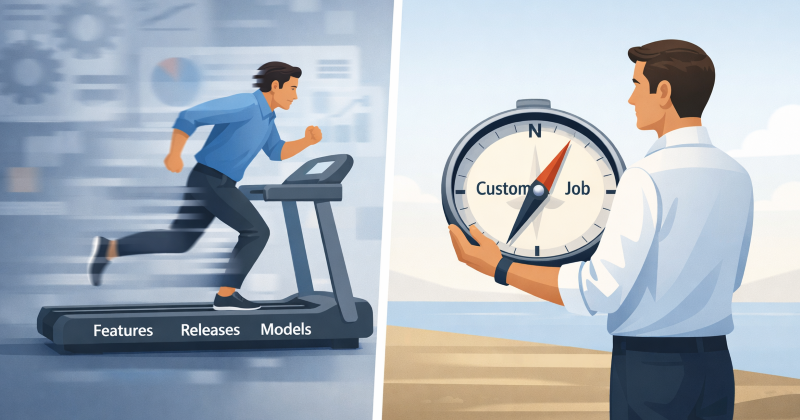
The result is that many AI teams respond by running faster. They ship more features. They chase every new model capability. They try to keep up.
But what Elena Verna is really describing is not a speed problem; it’s a direction problem.
Many AI companies are stuck on that treadmill dynamic. There is constant motion, constant urgency, and constant pressure to move faster. Yet despite all that activity, they remain strategically exposed.
What is missing is not effort or velocity; it’s a compass.
Without something to orient decisions, every competitor move feels threatening. Every feature release feels necessary. Product-market fit feels fragile, because nothing clearly anchors it.
The Real Problem
The real problem is that most AI companies are using the traditional approach to defining target markets: demographics and firmographics. They haven’t integrated Jobs-to-be-Done thinking, which transforms how target markets are defined. So, they’re left iterating frantically, competing on features, hoping something sticks.
To be clear, I’m not talking about foundation model providers like OpenAI, Google, or Anthropic. Those companies have clear strategic compasses. I’m talking about the thousands of AI application companies building products on top of those models, the AI coding tools, design assistants, content generators, and automation platforms that are struggling to build durable product-market fit.
When AI executives look at their fragile PMF, they see external forces they can’t control. But this exact pattern has played out before:
Mobile apps (2010-2014): Every app developer feared being buried overnight by Apple’s constantly changing store rankings.
Social platforms (2014-2018): Facebook kept changing how posts reached users, making yesterday’s viral strategy obsolete.
E-commerce brands (2018-ongoing): Rising advertising costs made customer acquisition feel unsustainably expensive.
Every fast-moving category eventually stabilizes around an understanding of the target customer and the core job they are trying to get done.
A target market is not just a demographic.
Saying “we serve developers” is incomplete. The question is: developers trying to get what job done?
Developers who look similar on paper can have very different jobs in very different circumstances. Consider:
A solo developer hacking on a personal project at night
A startup engineer racing to ship new features under runway pressure
An enterprise developer keeping a regulated legacy system stable
They all may share the same title, but in those circumstances they are trying to get different jobs done and will often rate the importance and satisfaction of the same outcomes very differently. That means they effectively sit in different markets, even when traditional demographics and job titles look the same.
A target market is defined as:
Target Market = Target Customer Group + The Core Job They’re Trying to Get Done
The demographic helps you identify who shares the same job. But without the job, you don’t have a target market. And without a target market, you don’t know what outcomes matter, who you’re really competing against, or what “better” even means.
This simple definition changes everything.
Why “Jobs” Matter
AI PMF feels fragile because most AI companies are competing on features. Features come and go, but customers’ jobs are stable over time.
The job of “launching a functioning web application” hasn’t fundamentally changed in decades. The job of “analyzing company financials for investment decisions” has remained constant since analysts existed. While new jobs can emerge from technological advances, regulatory changes, or new work models, the core jobs customers are trying to get done remain far more stable than the solutions used to accomplish them.
AI features change rapidly. If you compete on features, every model improvement by any competitor will threaten your differentiation.
This is why companies with clearly defined target markets (customer group + job) build durable businesses even in fast-moving categories. They’re not chasing the latest AI capabilities. They’re focused on helping specific customers get specific jobs done better than any alternative.
Solutions change rapidly. Jobs provide a stable North Star.
The Path Forward
If you’re an AI company worried about your PMF, here’s the question that matters:
Can you complete this sentence:
“We serve [specific customer group] who seek to [specific core job].”
Not:
“We serve developers” (which job)
“We serve people who want AI-generated code” (that’s a feature, not a job)
“We serve businesses that need automation” (automation to do what)
But:
“We serve non-technical founders who seek to launch functioning web applications”
“We serve enterprise developers who seek to build and deploy features with fewer defects”
“We serve financial analysts who seek to analyze company financials for investment decisions”
If you can’t complete this sentence with specificity, you don’t have a well-defined target market. You’re competing on features by default. And you’ll stay on the treadmill no matter how good your AI gets.
The companies that survive the next 12 months won’t be the ones with the best models. They’ll be the ones who understand this simple truth: customers don’t hire you for your AI features. They hire you to get their important jobs done.
Define the customer group. Define the job you can help them get done better. Build your strategy around helping them get that job done better than any alternative.
That’s how you get off the treadmill.