
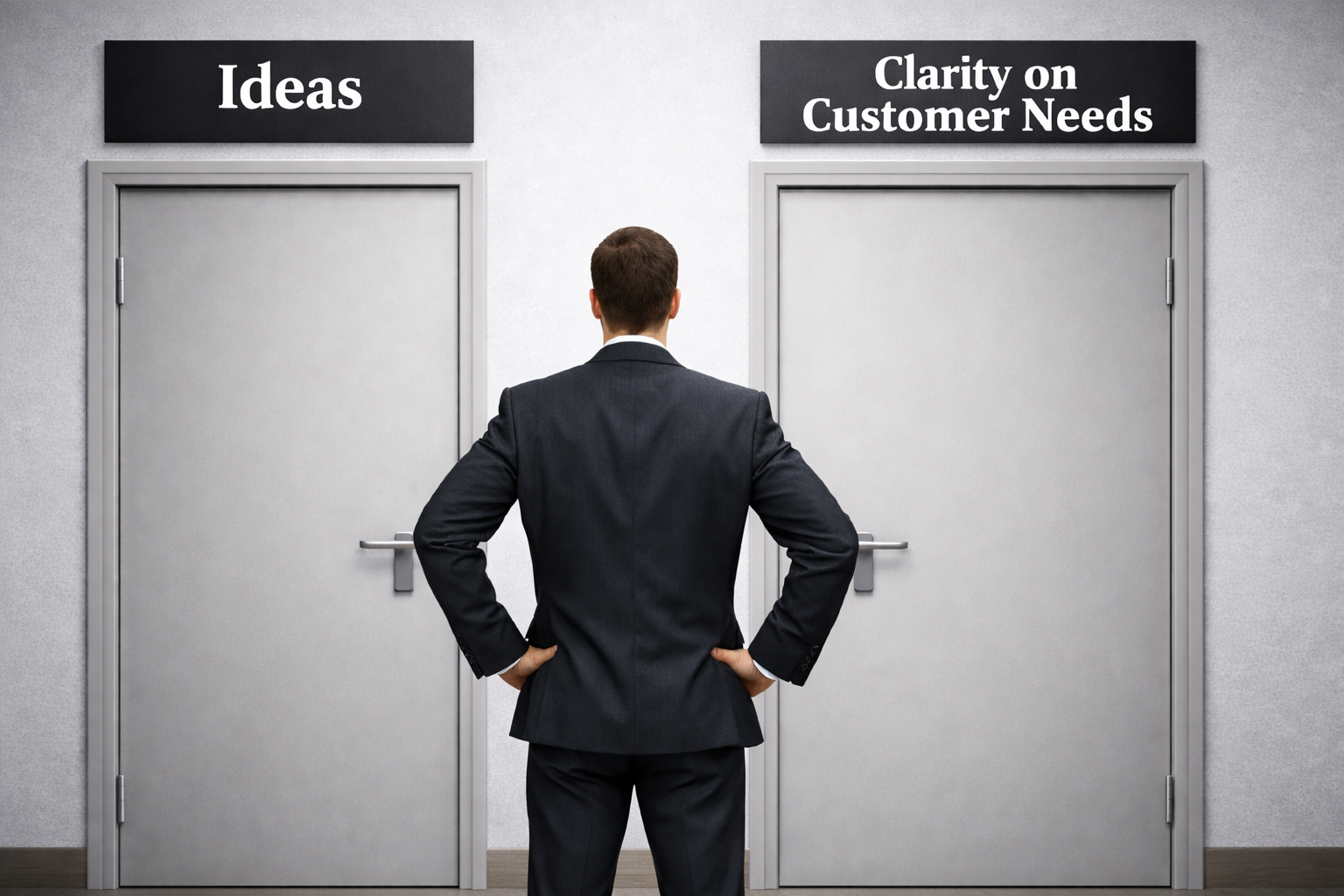
The Hidden Reason Innovation Feels Riskier Than It Should
Most leadership teams can recognize this moment.
A strategy offsite ends with a long list of initiatives everyone agrees are “promising.” The discussion was thoughtful. The data was solid. The energy in the room was high.
Yet when the team reconvenes weeks later, momentum has evaporated.
Nothing meaningful has moved forward. Not because the ideas were bad, but because no one could say with confidence which initiatives actually mattered most to customers.
Why Momentum Dies After Strategy Offsites
The conversation stalls in familiar places. Competing priorities. Differing opinions. Requests for more analysis. A call to “test and learn.” Eventually, the portfolio thins not through conviction, but through time, politics, or whoever has the most airtime in the room.
What looked like innovation quietly turns into inertia.
The Problem Is Not Leadership or Ideas
That experience is not a failure of leadership, creativity, or intent. It is what happens when organizations are forced to generate ideas about what to build before they have clarity about which customer needs are truly worth addressing.
What the PwC Data Actually Reveals
And according to PwC’s latest Global CEO Survey, this tension is far more common than most leaders would like to admit.
PwC’s 29th Global CEO Survey reports that half of all CEOs say innovation is central to their business strategy. Yet only 8% say they have made significant moves to implement the practices that make innovation actually work.
PwC recommends building innovation hubs, auditing innovation capability, finding partners, and codifying processes to shut down underperforming initiatives.
All of that is sensible structural advice.
The Question That Quietly Stops Progress
But none of it answers the question that quietly stops progress in so many leadership rooms:
“How do you know which customer needs are worth pursuing in the first place?”
Why Customer Data Creates False Confidence
Here is what makes this harder than it looks.
Research from PwC, Gartner, and Salesforce consistently shows that executives dramatically overestimate how well they understand their customers. Depending on the study, 54% to 78% of leaders believe their company understands customer needs. Only 18% to 30% of customers agree.
That is not a small gap; it’s a chasm. And it is not because leaders are careless or uninformed.
Most companies are drowning in customer data. Surveys. NPS scores. Focus groups. Journey maps. Personas. Feature requests.
The data is abundant. Yet customers are signaling, in countless ways, that something important is not working for them.
What Customer Feedback Rarely Tells You
The problem is not a lack of data. It is the wrong kind of data.
Most customer research asks some version of “What do you want?” or “What would you change?” Those questions invite customers to design your product for you. The feedback feels like understanding. It fills dashboards and quarterly presentations.
But it is organized around solutions, not around what customers are actually trying to accomplish.
It never answers the questions that determine innovation success:
- What job is the customer trying to get done?
- What outcomes do they use to measure success?
- Which of those outcomes are going unmet?
Without those answers, teams cannot distinguish real opportunities from noise. So, they brainstorm. They debate. They pick the most popular options. They build MVPs, iterate, and hope.
That is not an innovation strategy. That is expensive trial and error.
Where Innovation Risk Really Comes From
The gap PwC identified is not really between innovation ambition and innovation action. It is between assumed understanding and decision-grade clarity about customer needs.
Companies have the ambition. They have the data. What they lack is a systematic way to discover what customers are trying to accomplish before deciding what to build.
The Gap Between Assumed Understanding and Clarity
Most teams have never been shown how to do this. That is not a personal failure. It is a gap in how the industry has evolved.
It is also a gap we can close.
Where does innovation feel riskiest in your organization today, before ideas are generated or after they are chosen?
If this article resonated, I am finishing a short free Customer Needs Guide that illustrates the difference between surface-level customer data and decision-grade customer insight. You can get priority access when it is released here: [Get Priority Access]
The language of identifying and prioritizing important, unsatisfied customer needs as outcomes was pioneered by Tony Ulwick.