
Before You Build an MVP, Do MVD
Nearly every senior executive, founder, and innovation professional knows the concept of a minimum viable product (MVP). Build the most basic version of a product idea, test it with customers, and learn. The idea endures because it promises to enable teams to test their assumptions about customers and their solution before investing significant resources.
In practice, however, too many innovation professionals struggle to understand their customers’ unmet needs, because the tools they use were built for a different job. The build-test-learn cycle tests whether a solution works. It does not, by itself, reveal the customers’ unmet needs.
Ideally, every innovation team should be able to determine its target customers’ unmet needs and evaluate which are attractive to pursue for new value creation before building anything. This requires a different approach that answers the questions about your target customers’ unmet needs first so you can cleanly test the efficacy of your MVP.
But how much discovery is enough before you commit? Jobs-to-be-Done thinking has been clear for more than two decades about what type of customer inputs reveal unmet needs: the job the customer is trying to get done and the outcomes they use to measure success. Tony Ulwick’s Outcome-Driven Innovation® supplies the precise language for capturing both. What I have not found defined anywhere is the minimum: the smallest set of those inputs a team needs to guide idea generation and build a winning MVP.
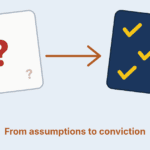
I call the missing standard Minimum Viable Discovery, or MVD. Just as an MVP is the simplest testable product, MVD is the smallest set of customer inputs needed to decide, with conviction, where to focus and what to do to create new value. Obtaining these inputs anchors your innovation decisions in customer reality rather than assumptions.
When the need is not important to the customer, or already satisfied, or a phantom need, every solution built on it is aimed at an opportunity that does not exist. CB Insights’ post-mortems of failed startups document the pattern: in its March 2026 analysis of VC-backed shutdowns, running out of capital was the most-cited reason, but the researchers note that capital exhaustion is almost always the final cause of death, not the root problem. The leading root cause they identify is poor product-market fit.
That aligns with what Nathan Furr and Paul Ahlstrom conclude in Nail It Then Scale It: “over 90% of businesses fail because they couldn’t get anyone to buy it, not because they couldn’t build it.” In other words, market risk (the risk of misunderstanding what customers want) is a significantly larger risk than solution risk (the risk of not being able to make what customers want).
Nor is the pattern confined to startups. Robert Cooper’s 2019 synthesis of decades of new-product development research found that a strong market orientation is missing in the majority of firms’ new product projects, even though virtually every study of product success factors supports its importance. Successful firms spend about twice as much time and money as unsuccessful firms on front-end discovery, and that homework pays for itself in higher success rates and shorter development times.
If you launch an MVP without first identifying the customers’ unmet needs, you end up testing two hypotheses in a single experiment: Is the need real, and is the solution effective? This confounds the very learning the test was supposed to deliver. When the market doesn’t respond the way you had hoped, it’s hard to tell what went wrong: was it the need or the solution? This ambiguity can lead to excessive iterating, pivoting, and cash burn. Discovering the unmet jobs and outcomes first takes that ambiguity out of the test.
Not every innovation decision needs the same depth of discovery. When the investment is small, or the decision is easily reversed, iterating your way to the answer may carry acceptable risk. But teams tend to rate their own customer understanding far higher than their customers do. The gap keeps being rediscovered: in 2005, Bain found that 80 percent of companies believed they delivered a superior customer experience while 8 percent of their customers agreed; Capgemini found in 2017 that 75 percent of companies believed they were customer-centric while 30 percent agreed; and PwC’s 2024 trust survey found that 90 percent of executives believed customers highly trusted their company while 30 percent of customers said they did. Two decades of measurement, and the gap does not close on its own.
Market risk is present in every initiative. So, the real question is not whether it exists but whether your organization can absorb the consequences when it materializes. MVD is how you lower that risk before you commit.
MVD begins with your strategic objective. That is the business result you intend to achieve through this innovation initiative. This frames everything that follows including which target customer and which job or jobs to investigate.
Then MVD asks five questions, framed the way a journalist frames a story: who, what, where and when, why, and with what consequences. Leadership answers the first two. Customers answer the last three.
1. Who is the target customer?
2. What job or jobs are they trying to get done?
3. Where and when do they struggle to get it done?
4. Why does the need remain unmet?
5. What are the consequences if the need continues to go unmet?
The structure of these five questions holds across all five discovery strategies in the system. The discovery strategy sets the focus, breadth, and depth of the investigation.
The value is in the type of inputs a trained JTBD practitioner can elicit from target customers: the specific job they are trying to get done, the desired outcomes that remain unmet, why they remain unmet, and what it costs them. Together, they tell the story of your target customers’ unmet needs. That story is the foundational information every company should know about its customers, and it strengthens every downstream customer-facing, value-creating activity. These inputs enable teams to generate ideas that have conceptual product-market fit built in at creation.
A familiar objection arises here. Henry Ford is often credited with saying that if he had asked customers what they wanted, they would have asked for a faster horse. Steve Jobs argued that people do not know what they want until you show it to them. Both lines get used to justify skipping customer conversations entirely. They are only half right.
Customers genuinely cannot tell you what to build, but they absolutely can tell you what they want to accomplish and where they struggle. But you must know what type of customer inputs to obtain and how to get them. Even a first pass helps: simply asking the five questions of MVD and capturing the answers as jobs or outcomes with no reference to any product or service is a dramatic step forward for many teams.
Often, however, the real gold is mined in the back-and-forth conversation, where the deeper inputs surface. This is where the resemblance to journalism ends. A journalist captures what people say. A JTBD interviewer probes what it means, asking questions like “Why is that important to you?” and “What will that do for you?” until the inputs you need to achieve your strategic objective are identified and confirmed with the customer.
MVD is the discovery discipline at the heart of Lean JTBD OS®, the operating system I developed to turn the front end of innovation into a repeatable, reliable business process. The system equips leaders to achieve the strategic objectives that businesses often fund: differentiate a core offering, find and capitalize on adjacent markets, increase customer retention, as well as find and target different customers. Lean JTBD OS® provides clarity and direction for an innovation initiative from its start, through customer interviews, and landing on conceptual product-market fit at idea generation. Its designed to keep JTBD discovery as simple as possible and only as complex as necessary.
If you lead a business and want to de-risk your next innovation investment before spending money, or you guide discovery, product, or innovation decisions, here are two ways to put MVD to work for you.
This fall I’m publishing The Customer Needs Discovery Guide, a focused practitioner guide to MVD: the five questions in full and how to use them.
Shortly after, a Level 1 certification course accredited by the Global Innovation Management Institute (GIMI) walks you through the complete Lean JTBD OS® step by step, so your team can run disciplined discovery as a repeatable practice.
The Guide comes first. Join the waitlist to get your copy the moment it’s available: https://revealgrowth.com/customer-needs-guide-waitlist/
Sources:
- Allen, J., Reichheld, F. F., Hamilton, B., and Markey, R., “Closing the delivery gap: How to achieve true customer-led growth,” Bain & Company, 2005.
- Capgemini Digital Transformation Institute, “The Disconnected Customer: What Digital Customer Experience Leaders Teach Us About Reconnecting with Customers,” 2017.
- CB Insights, “The Top 9 Reasons Startups Fail,” CB Insights Research, updated March 5, 2026. https://www.cbinsights.com/research/report/startup-failure-reasons-top/
- Cooper, R. G., “The Drivers of Success in New-Product Development,” Industrial Marketing Management, 76 (2019), pp. 36–47. https://doi.org/10.1016/j.indmarman.2018.07.005
- PwC, “2024 Trust Survey: Trust in US Business,” PwC US, 2024.
- Reinhardt, A., “Steve Jobs: ‘There’s Sanity Returning,'” BusinessWeek, May 25, 1998.
- Ulwick, A. W., and Bettencourt, L. A., “Giving Customers a Fair Hearing,” MIT Sloan Management Review, 49(3), Spring 2008.