I don’t have to tell you that even well-planned, well-funded, and well-executed innovation initiatives fail at a high rate. If you are a senior leader with P&L responsibility, you have probably been part of a leadership team that approved one. And if you are an innovation professional, you have probably proposed one. In most cases, the plan seemed to be sound, the assumptions were pressure-tested, the return held up in the downside case, the market was sized, sales reported that customers were asking for it, it fit your strategy, and the team was confident they could build it. Yet it failed.
Jerry Neumann, writing in Colossus this past March, found that the share of new companies surviving one, two, five, and ten years has been essentially unchanged since 1995, through three decades of widely adopted methods for improving the odds. Inside established companies the record is thinner, but it points the same way.
Most people accept these results as the cost of doing business because innovation is inherently risky, right? I would argue that something else is going on: innovation initiatives are funded without the right kind of customer insights. Not all customer insight is equal.
The Failures Originate in the Market, Not the Build
CB Insights examined 431 funded companies that shut down since 2023. Seventy percent ran out of capital, which the researchers call the final cause, not the root. The leading root cause was poor product-market fit, at 43 percent. Poor product-market fit can be the result of misunderstanding what customers want or not being able to make what they want. CB Insights reported that two-thirds were early-stage companies that “never found a market,” and the later-stage ones had early traction that “never widened into a real market.” CB Insights’ own description settles which it was. A company that “never found a market” misread what customers needed or misjudged how many needed it; it did not fail to build the product. Nathan Furr and Paul Ahlstrom, in Nail It Then Scale It, put it more bluntly: over 90 percent of new businesses fail because they could not get anyone to buy their offering, not because they could not build it.
The research on established companies points to the same cause from the other direction. It looks at what successful new-product initiatives do, not at why they fail, and it also finds upfront market research missing. Robert Cooper, co-founder of the Stage-Gate process, synthesized decades of that research in 2019 and found that a strong market orientation is missing in the majority of firms’ new-product projects.
It helps to remember that every innovation initiative carries two kinds of risk. Solution risk is the risk that we cannot build and deliver what we propose. Market risk is the risk that customers do not need what we make, and it is the one risk the company cannot settle on its own. Only customers can tell you whether they need what you are about to make. Customers are the source of truth.
This is how an initiative can be well-planned, well-funded, and well-executed and still fail. Planning, funding, and execution address solution risk, and often do not tell you whether customers need what you are building.
The Business Case Funds a Hypothesis About the Need
Ask leadership and the innovation team, and they will often say the case rests on a hypothesis about customer need, backed by research. That is accurate, and it is where the trouble starts, because the company has accepted that a hypothesis is the best information it can have before the product exists.
The belief behind that is that customers cannot tell you what they need until they have something to react to. That is only half true. Customers cannot tell you what to build, but they absolutely can tell you what they are trying to get done and where they struggle, before anything is built, but you have to know what to ask. My next article shows how.
A hypothesis about what customers want is a hunch, however much research sits under it, unless you know what customers are trying to get done, where they struggle today, and how they measure success. What customers tell you about those three things is a promise, because together they explain why they would buy.
What the Review Tests and What It Cannot
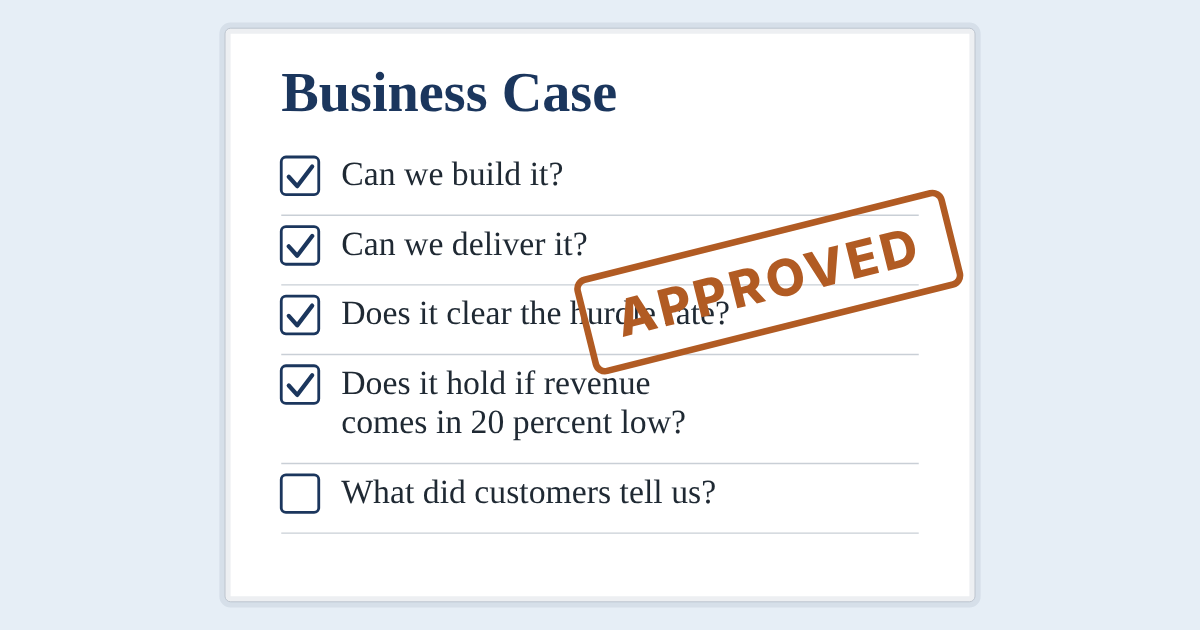
Consider what a business case review does with the hypothesis it has. It effectively answers a lot of important questions. Can we build it? Can we deliver it? Does it clear the hurdle rate? Does it still clear the hurdle rate if revenue comes in 20 percent low? Every one of those questions takes the revenue assumption as an input and tests the arithmetic around it. A sensitivity analysis can show you the return if demand comes in weaker than forecast. What it cannot do is tell you whether the hypothesis is true. Only customer input of the right kind can do that, and the input behind the forecast is usually not that kind.
The research behind a hypothesis can be vast. Usually, it includes significant analyses about market sizing, concept testing, market level research, and what sales hears from customers. The problem is the type of information obtained. Even when sales is talking with customers, what often comes back from the field is a mix of requests, impressions, and inference. Unless the customer’s jobs and desired outcomes have been captured deliberately, significant risk of misunderstanding what customers want will remain. “What customers want” has two meanings: the features they would like or the result they want. A request is the first kind. It is framed by the products the customer already uses, so it is often useful for improving those products, but it does not reliably tell you the second, which is the question funding should depend on.
I would argue that the business case for a new offering suffers from the same problem that teams experience through development: a lack of the right type of customer information to guide action and investment. The team is not short of customer input; it is short of the kind of input that tells you whether customers really need what you are about to make, that is, whether it addresses a need that is both important to them and unsatisfied by current solutions.
That’s not anyone’s fault. It’s due to the fact that most people simply don’t know what information to obtain from customers or how to get it. If the team does not know what the target customer is trying to get done, where they struggle getting it done, and how they measure success, the case holds incomplete information at best and faulty information at worst. Most companies believe they are mitigating market risk through the iteration that follows funding, but the same gap still remains there.
Iterating After Funding Is the Slow and Expensive Way to Learn
Mechanics have a name for the way repairs are sometimes made. If the car runs rough, the likeliest part gets replaced, then the next one, and so on until it runs smooth. They call it “firing the parts cannon.” A skilled mechanic diagnoses first, finds the one component that failed, and replaces that. Both end with a repaired car, and one of them costs three parts and a month. Iterating toward the need after funding works the same way: each pilot or minimum viable product is the next part.
Iteration is a good tool for mitigating solution risk, but it is not the right tool for mitigating market risk. A pilot or a minimum viable product runs two experiments at once, one on the perceived customer need and one on the solution, and when it fails the team often cannot tell which experiment failed. Was the need not there, or did the solution not address it? So, the team adjusts the solution and tries again, which is a slow and expensive way to learn. Neumann’s record is consistent with this: three decades of these methods, and survival rates have not moved.
How I Learned This
Years ago, I joined a small but promising managed behavioral healthcare company as its only salesperson. The CEO, a psychiatrist, was very confident in the clinical outcomes we delivered. Our care was demonstrably higher in quality than the programs we competed against, and the firm had always been confident that the Senior Benefits Managers, who were the final decision-makers, would follow their Medical Directors’ assessments. Yet, when I arrived, the firm had lost a few large bids to programs that were believed to deliver weaker clinical outcomes. I took it upon myself to reach out to a few Senior Benefits Managers who had selected us as well as a few who had passed over us.
The interviews were brief but telling. The most important thing I learned was that, to them, quality meant “no noise”: minimal employee complaints, quick resolution of issues, and seamless administration. They conceded that the medical outcomes we delivered were impressive but not the only thing they wanted. We revised our value proposition accordingly, and bid performance and growth improved. Notice that our resources were the same as before; the difference was that now we knew where to focus and what to do to win.
Why It Goes Unseen
If you are thinking that your company already understands its customers well enough, consider three studies that compared what companies believe about themselves with what customers say. Bain surveyed 362 firms in 2005: 80 percent believed they delivered a superior experience, and when Bain asked customers, 8 percent of companies were delivering one. Capgemini in 2017: 75 percent of organizations believed they were customer-centric, and 30 percent of consumers agreed. PwC in 2024: 90 percent of executives believed customers highly trusted their companies, and 30 percent of consumers said they did. Each study measured a different dimension, and the gap has the same shape in all three. This is known as the Perception Gap, and because it is a cognitive bias, every team is vulnerable to misjudging what it really knows about its customers’ needs.
When questioned more closely, I have found that many leaders understand this risk. In 2024 I interviewed twelve senior executives with responsibility for growth or innovation across several industries. Most acknowledged that their understanding of customers was partial or assumption-based. A Director of Engineering put it this way: “It’s like going to a casino where you don’t know the rules or the payout. You’re not going to place a big bet there.” This leads to paralysis or recklessness. What people want is conviction based on evidence.
Why It Is Cheap to Fix
The fix is to find out what customers need before idea generation or, at least, before any significant investment. A handful of conversations with the customers you intend to serve, and the buyers if different, asking them what they are trying to accomplish and where they struggle, will usually show you where their needs are unmet, and that is where ideas should start. If an idea already exists, the same conversations tell you whether it addresses one of those needs.
Cooper’s research says this homework pays for itself: successful firms spend about twice as much time and money as unsuccessful firms on front-end activities, and recover it in higher success rates and shorter development times. That finding is about how much time and money firms spend, not about what information the work obtains, which is a separate question. So two things are often missing: the practice of asking customers before the budget is committed, and, when companies do ask, clarity about what information to obtain.
Two Questions
Most business cases earn the confidence of leadership by doing a solid job of mitigating solution risk, and by assuming that a strong hypothesis is the best you can do about market risk until you launch a pilot or a minimum viable product. That assumption is the flaw, because market risk is the leading cause of failure and a hypothesis is not the best you can do. Customers can tell you, before anything is built, what they are trying to accomplish and where they struggle, and that is the information the case is missing. Every business case should include the answers to at least these two basic questions, obtained by talking with customers: What are you trying to accomplish? Where do you struggle to get it done?
Does your approval process produce those answers today? How to get them, and how to make them part of the case before the budget is committed, is the subject of the next article in this series.
About Lean JTBD OS®
Lean JTBD OS is a qualitative, AI-augmented front-end innovation operating system designed to make customer discovery more practical, accessible, and actionable for modern innovation teams. It uses language from Outcome-Driven Innovation® (ODI) developed by Tony Ulwick, with his permission. It is designed to make qualitative discovery as simple as possible and only as complex as necessary for confident innovation decisions.
For senior leaders, it is a resource allocation tool: it establishes what customers are trying to get done and where they struggle before the budget is committed.
For innovation professionals, it is a repeatable discipline for producing that evidence, in a form a leadership team can act on.
The Customer Needs Discovery Guide teaches Minimum Viable Discovery (MVD) the practical system for getting those answers. Before you build an Minimum Viable Product (MVP), go MVD. Get the minimum viable set of customer inputs you need to make your innovation decisions with conviction. The Guide will sell for $49 upon public release; waitlist members receive it first at no cost. Get Priority Access to the Guide.
Sources
- Allen, James, Frederick F. Reichheld, Barney Hamilton, and Rob Markey. “Closing the Delivery Gap.” Bain & Company, 2005.
- Capgemini Digital Transformation Institute. “The Disconnected Customer: What Digital Customer Experience Leaders Teach Us About Reconnecting with Customers.” Capgemini, 2017.
- CB Insights. “The Top 9 Reasons Startups Fail.” Updated March 5, 2026.
- Cooper, Robert G. “The Drivers of Success in New-Product Development.” Industrial Marketing Management 76 (2019), pp. 36–47.
- Furr, Nathan, and Paul Ahlstrom. Nail It Then Scale It: The Entrepreneur’s Guide to Creating and Managing Breakthrough Innovation. NISI Publishing, 2011.
- Neumann, Jerry. “We Have Learned Nothing.” Colossus, Issue 06, March 2026.
- PwC. “2024 Trust Survey: Trust in US Business.” PwC US, 2024.
- Wood, Urquhart. “Why Differentiation & Innovation Efforts Stall: Five Challenges Leaders Can’t Afford to Ignore.” Reveal Growth Consultants, revised April 21, 2025.