
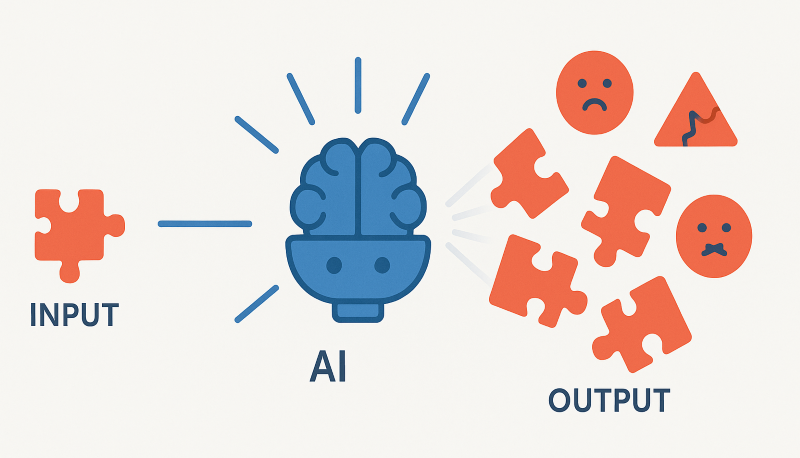
Companies are rushing to implement AI-driven customer insights, chatbots, and predictive analytics. The problem is, AI can do the work, but it can’t decide what work should be done. That decision must be rooted in customer understanding.
Most innovation teams lack the operating system AI needs to succeed.
The Amplification Problem
Kentaro Toyama’s research in Geek Heresy reveals a fundamental truth: technology amplifies intent – it doesn’t fix what’s broken. When teams implement AI without first understanding what customers are actually trying to accomplish, they don’t get breakthrough insights. They get scaled confusion.
Consider what happens when AI analyzes customer feedback without a structured foundation:
- Sentiment analysis captures emotions (“frustrated,” “satisfied”) but misses functional needs
- Machine learning optimizes existing solutions instead of identifying new opportunity spaces
- Predictive models reinforce historical assumptions rather than uncovering emerging needs
The result? Companies that misunderstand their customers simply scale their misunderstanding with AI, leading to wasted investment and missed opportunities.
The Missing Operating System
Just as a computer’s operating system provides the foundation for all applications to run effectively, innovation teams need a customer understanding foundation that helps them find the right problems before AI accelerates their solutions.
That’s where Lean JTBD OS™ comes in. It’s a front-end operating system for innovation that doesn’t compete with Design Thinking, Agile, or Lean Startup – it precedes and complements them. It simplifies customer discovery to three core questions that structure how AI should analyze customer data:
- What are customers trying to accomplish? (Jobs)
- What steps must they go through – independent of product or service solutions – to successfully complete the job(s)?
- What makes executing each step frustrating or difficult? (This directly uncovers important, unsatisfied needs)
Without this foundation, AI tools detect surface-level patterns when the deeper insights remain hidden. One private jet company discovered their business travelers weren’t just trying to “get from A to B efficiently”—they were trying to “maintain anonymity for sensitive M&A negotiations” and “minimize wear and tear on the executive team.” AI analyzing generic travel feedback would never surface these insights, but structured customer discovery revealed premium-pricing opportunities that transformed their business model.
From Guessing to Knowing
Lean JTBD OS™ applies the 80/20 rule to customer discovery. By skipping statistical validation and complex segmentation while preserving the core logic that makes Jobs-to-Be-Done powerful, teams get 80% of the value at a fraction of the cost, time, and complexity.
Teams using this operating system stop guessing and stop spinning. They align faster on what to build, why it matters, and how to deliver value. From UX researchers to product managers to innovation managers—everyone finally shares a common view of the customer.
The Foundation AI Needs
AI amplifies your existing customer understanding, whether it’s accurate or not. Before building AI solutions, make sure you understand what customers want to accomplish and how they measure success. The most successful AI implementations don’t start with technology at all. They begin by identifying high-impact customer problems worth solving. They systematically understand what customers are trying to accomplish, identify the most important unsatisfied needs, and make strategic decisions about opportunities to pursue before introducing automation.
This shift changes everything:
FROM: “We need AI to remain competitive”
TO: “We need to solve these specific customer struggles”
FROM: “What AI capabilities should we implement?”
TO: “Which important, unsatisfied needs should we address?”
As one Head of Market Research put it: “I’ve participated in probably more than 100 JTBD projects over the years, and I’ve yet to see a case where it fails to deliver. I’ve seen teams fail to capitalize on the insights JTBD uncovered, but I’ve never seen the approach itself fail to uncover insights that pointed to potentially game-changing new product/service concepts.”
Your Invitation
If you’re tired of moving fast in the wrong direction, it’s time to slow down – just enough to ask better questions, hear better answers, and make smarter moves.
I’ll be sharing an overview of Lean JTBD OS™ with the Global Innovation Management Institute’s community online on July 2, showing how to build a foundation of customer understanding that makes AI-driven innovation – all innovation – a repeatable business process.
Join me on July 2nd to learn more about Lean JTBD OS™ – a simpler, more accessible way to uncover and capitalize on your target customers’ unmet needs.
Register here and simply choose the July 2 meeting.